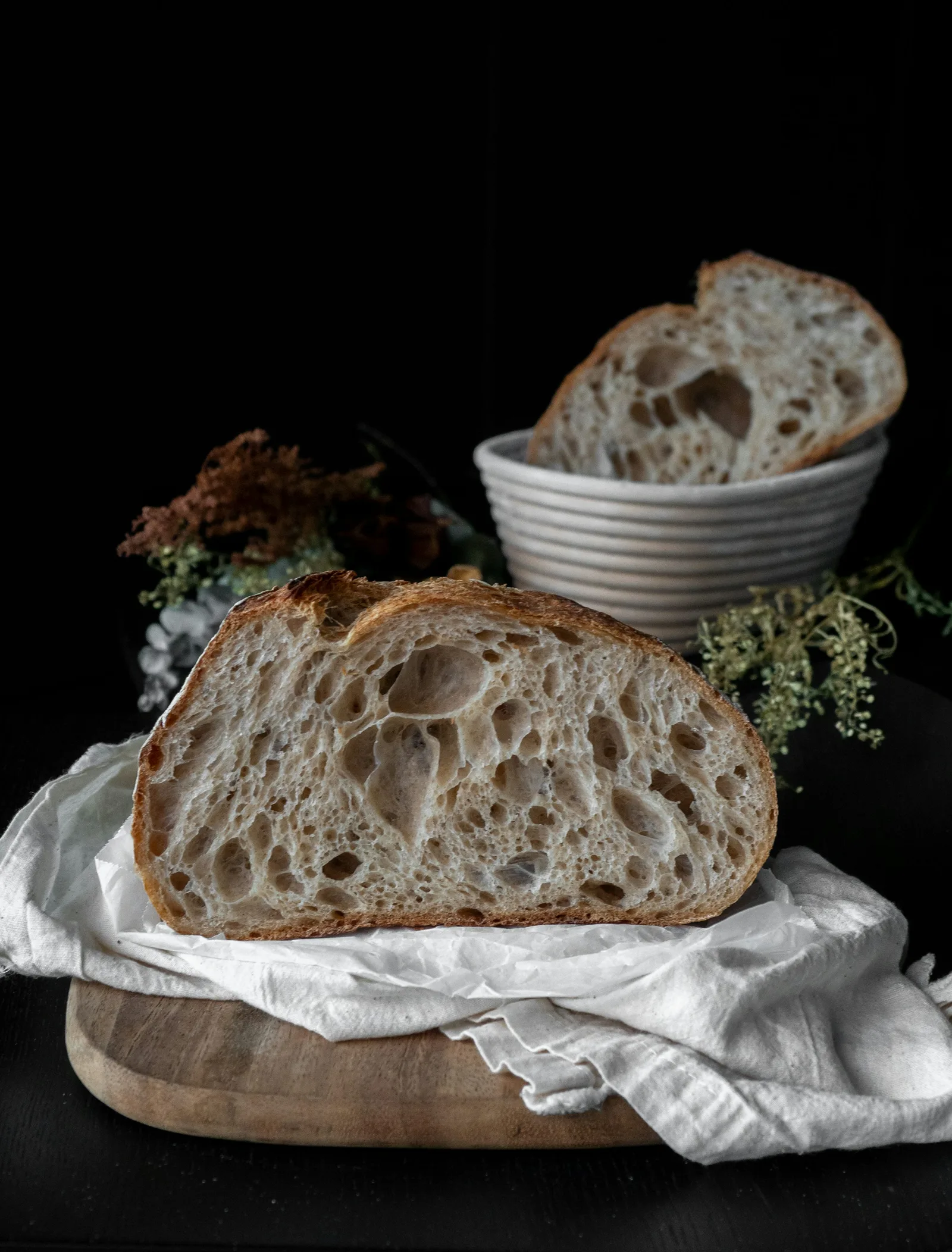
Hydration is total water divided by total flour, including the starter. Flour choice and handling still affect how wet a dough feels.
- Count both parts of the starter.
- Compare similar flours before comparing handling.
- Change hydration deliberately and record the result.
Hydration is a ratio, not a difficulty score
Sourdough hydration is total water weight divided by total flour weight, expressed as a percentage. A dough containing 700 g water and 1,000 g flour is at 70% hydration. The flour and water carried by the starter belong in both totals. This convention lets you compare ingredient composition even when two recipes list their mixing ingredients differently.
Hydration does not measure how accomplished a baker is, and a higher number is not automatically a better choice. The useful question is whether a particular formula suits the flour, loaf style, and handling method you plan to use. King Arthur Baking’s explanation of bread hydration supports the basic definition and the inclusion of preferment ingredients. The examples below show how to apply that definition without hiding the starter’s contribution.
Start with four pieces of information
For a lean dough, record fresh flour, fresh water, starter weight, and starter hydration. Fresh means added at final mixing; it does not include the ingredients already inside the starter. Use one unit of weight throughout. Grams work conveniently because you can weigh flour, water, and starter without switching between volume measures.
Suppose your mixing list contains 500 g flour, 330 g water, and 100 g starter at 100% hydration. The starter contains 50 g flour and 50 g water. Total flour is therefore 550 g and total water is 380 g. Hydration is 380 ÷ 550 × 100, or about 69.09%. Dividing only 330 by 500 would give 66%, which describes the fresh additions rather than the whole dough.
Why including starter changes the result
In that example, the fresh flour and water are at 66%, while the starter is at 100%. Combining them moves the overall ratio toward the wetter mixture. It does not make the dough 166% hydrated, and you cannot average 66 and 100 directly because the two mixtures contain different flour weights.
A flour-weighted calculation gives the correct result: (500 × 0.66 + 50 × 1.00) ÷ 550 = 0.6909. This is the same arithmetic as adding all water and dividing by all flour. The longer form is useful when comparing several preferments or dough components, but the total-water method is usually easier to audit. Each component contributes its actual flour and water, not one equally weighted vote.
Starters that are not at 100%
Starter flour = starter weight ÷ (1 + starter hydration as a decimal). Starter water is the remaining weight. For 150 g starter at 50% hydration, flour is 150 ÷ 1.5 = 100 g and water is 50 g. For 150 g starter at 125%, flour is 150 ÷ 2.25, or approximately 66.67 g, and water is approximately 83.33 g.
If either starter is mixed with the same 500 g fresh flour and 330 g fresh water, the doughs differ. The stiff-starter version has 600 g flour and 380 g water, giving 63.33%. The liquid-starter version has approximately 566.67 g flour and 413.33 g water, giving 72.94%. Identical starter weights are not interchangeable without adjusting the rest of the formula.
Build a target hydration deliberately
To design a dough, begin with total flour. For 600 g total flour at 72% hydration, total water must be 600 × 0.72 = 432 g. If you plan to use 120 g starter at 100% hydration, it supplies 60 g flour and 60 g water. The fresh additions are consequently 540 g flour and 372 g water.
Salt is weighed separately and does not enter the hydration fraction. At 2% of total flour, use 12 g salt. The mixing list is 540 g flour, 372 g water, 120 g starter, and 12 g salt. Checking the totals before mixing is worthwhile: flour is 600 g, water is 432 g, and dough mass is 1,044 g. These are calculated quantities, not a complete fermentation or baking schedule.
Hold back water without losing the calculation
A water holdback is part of the planned water, not an extra ingredient. If the mixing list calls for 372 g fresh water, you might initially add 342 g and reserve 30 g. With the starter’s 60 g water, the dough initially contains 402 g water against 600 g flour, which is 67% hydration.
Adding all 30 g later returns the dough to 72%. Adding only 18 g produces 420 g total water, or 70%. If you decide not to use the full reserve, record the amount actually added. Otherwise a notebook may say 72% while the dough you baked was at 70%, making the next comparison confusing. Water used to dissolve salt or rinse starter into the bowl must come from the same measured allowance.
| Stage | Total water | Total flour | Hydration |
|---|---|---|---|
| Initial mix with 30 g withheld | 402 g | 600 g | 67% |
| 18 g of the reserve added | 420 g | 600 g | 70% |
| All 30 g of the reserve added | 432 g | 600 g | 72% |
Raising hydration by a chosen amount
When total flour stays fixed, a one-percentage-point hydration change needs water equal to 1% of flour weight. For 600 g total flour, that is 6 g water. Moving from 68% to 72% requires four percentage points, so add 24 g water. This is different from increasing the current water by 4%, which would produce a smaller change.
The distinction matters when instructions say to increase hydration by five percent without explaining the denominator. A 70% dough made with 600 g flour contains 420 g water. Five percentage points would bring it to 75% with 450 g water, an addition of 30 g. Increasing the 420 g water by 5% adds only 21 g, producing 73.5% hydration. Write percentage points when that is what you mean.
Lowering hydration is not the reverse of adding water
Before mixing, lower a target hydration by reducing the measured water. After water has been mixed into dough, it cannot simply be subtracted. Adding flour changes the denominator and also changes every flour-based percentage. To reduce a dough containing 432 g water from 72% to 68%, the required flour is 432 ÷ 0.68, or approximately 635.29 g.
That means adding about 35.29 g flour to a dough that originally contained 600 g. Its existing 12 g salt would then be about 1.89%, and its 60 g prefermented flour would represent about 9.44%. Restoring 2% salt would require a total of about 12.71 g. This calculation explains the consequences of a flour correction; it does not guarantee that late-added flour will integrate well into a developed dough.
Flour choice changes how hydration feels
The same water ratio can produce different handling characteristics with different flours. King Arthur Baking notes that flour composition affects water needs and that bakers may adjust water during mixing. A hydration number alone therefore cannot promise a dough that feels firm, stretchy, sticky, or easy to shape in your kitchen.
For a useful comparison, keep flour identity and blend consistent while changing one variable. Record the actual product, the proportions of different flours, and any water you withheld or added. If you replace a flour, treat the previous percentage as a documented starting point rather than a performance guarantee. There is more information in a clear record of ingredients and handling than in a high hydration label beside a loaf photograph.
What counts as water in a simple calculator
Plain water in the final mix, starter water, and measured water added in later stages all belong in the water total. Oil is not water. Salt and dry flour do not become water because they dissolve or absorb liquid. Seeds and dried fruit introduce other complications, especially when they are soaked before mixing.
A soaker should be recorded as dry inclusion weight plus water retained in the dough. If you pour off unabsorbed water without measuring it, the exact retained water is uncertain. Decide whether your reported figure describes flour-water hydration alone or a broader formula with hydrated inclusions. That labeling is more useful than silently treating a wet soaker as flour, water, or starter according to whichever calculator field happens to be available.
Enriched dough needs a stated convention
Milk, eggs, yogurt, and other ingredients contain water along with solids and sometimes fat. Counting their entire weights as pure water overstates their water contribution. Ignoring their water understates it. A basic sourdough hydration calculator should either exclude these formulas or clearly explain that it reports only water entered explicitly.
If you need an estimated total-water calculation, use documented composition data for the specific ingredients and record the assumptions. For example, an ingredient assumed to contain 80% water contributes 80 g water per 100 g used. That is an arithmetic illustration, not a claim about any named product. Ingredient variability and recipe conventions mean this estimate should not be presented as a laboratory measurement of the dough’s available moisture.
Rounding and small-batch effects
Calculate starter flour and water with full precision, then round mixing weights at the end. In a small dough, a single gram has a larger effect on hydration than it does in a large batch. One gram of water changes a 100 g flour dough by one percentage point, but changes a 1,000 g flour dough by only one tenth of a point.
After rounding the ingredient list, calculate the achieved hydration if you want an exact record. It is acceptable for a target of 72% to produce a practical list that works out to 71.9% or 72.1%. What matters is keeping target values separate from measured values and recognizing the resolution of your scale. A long decimal displayed by software should not imply that every ingredient was measured to that precision.
Compare doughs with a short record
For each bake, preserve the fresh flour and water weights, starter weight and hydration, total flour, calculated total water, and water actually used. Add observations about the flour, mixing method, temperature, and dough behavior. Keep calculated facts separate from impressions such as easy to handle or difficult to shape, so you can see which changes accompanied those impressions.
Avoid using hydration alone to explain a disappointing loaf. Fermentation, dough development, shaping, and baking are separate parts of the process. A more useful next experiment is often to keep the formula stable and improve the record, then make a small measured change. Hydration becomes a practical tool when it helps you repeat and understand a dough, rather than a number to chase for its own sake.
Sources & further reading
This guide combines published references with our own explanations and decision aids. Numerical examples are illustrative; they are not records of Sourdough Bench test bakes.
Put it into practice.
Keep the recipe, observations and next change together in your downloadable bake log. For a symptom-led starting point, use the loaf troubleshooting guide.