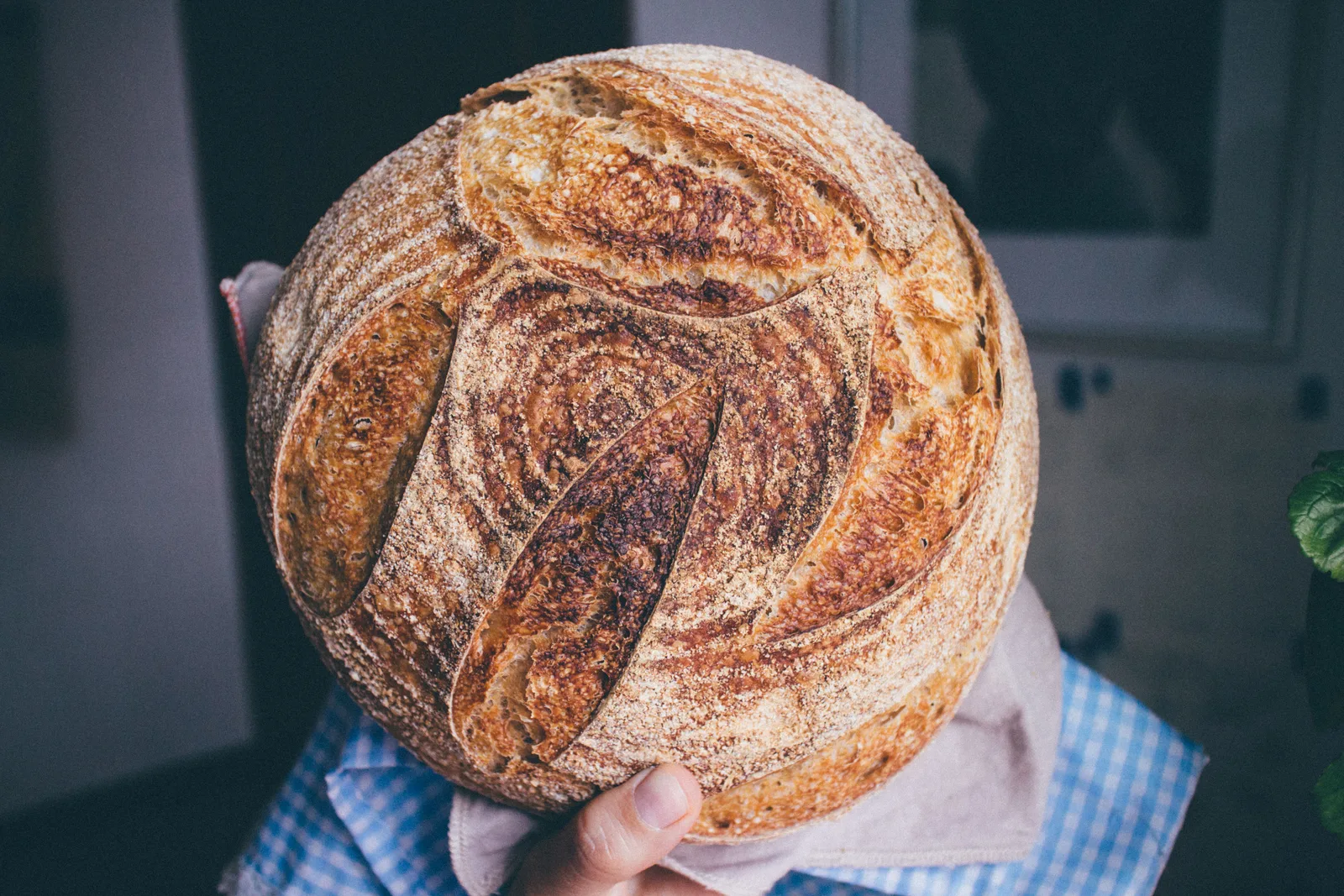
Begin with a simple functional score: one lengthwise cut for a bâtard or a balanced pattern for a boule. Plan the path before cutting, use a secure sharp tool, and match depth and tilt to the dough and recipe rather than a universal number.
- A decorative pattern does not automatically replace the main expansion cut.
- The cut’s path and the blade’s tilt are separate choices.
- Dragging can involve the tool, inclusions, or dough condition.
- Judge scoring together with shaping, proofing, steam, and the loading sequence.
Give the loaf a planned place to open
Scoring cuts the surface of a shaped loaf before baking so its expansion has a deliberate opening. For a first attempt, use a simple functional pattern suited to the shape: one lengthwise cut on an oval, or a balanced pattern on a round. Decorative detail can wait until the main opening behaves consistently. A complicated design adds decisions at the moment when a proofed loaf and prepared oven already require your attention.
This guide concerns the scoring of familiar lean wheat sourdough hearth loaves. Some breads are intentionally baked seam-side up, left unscored, or cut at a different stage; follow their complete methods. A blade does not repair poor fermentation, and a dramatic ear is not a universal measure of good bread. Your first useful goal is a clean, controlled cut and a loaf that opens where you intended.
Know the difference between a functional cut and decoration
A functional score provides room for the loaf to expand. A decorative mark primarily creates a surface pattern. The two can coexist, but a shallow drawn motif should not automatically be treated as a replacement for the main opening. Before picking up the blade, decide which marks serve which purpose. That decision prevents a common sequence of adding many tiny cuts, worrying that they are insufficient, and then slicing through the whole design at the last moment.
Sketch the pattern on paper using only the loaf outline and the main opening first. Add decorative marks afterward if you still want them. This paper exercise has no fermentation cost and does not require a sharp tool. If you cannot identify the functional opening on the sketch, simplify the plan. An attractive pattern should be the result of a deliberate layout, not an accumulation of marks made while trying to solve uncertainty on the dough itself.
Prepare the tool and the loading route
Use a scoring tool designed to hold its blade securely, and follow its instructions for assembly, replacement, and storage. Fit or change blades away from the dough and hot cookware. Keep fingers out of the intended cutting path, stabilize the work area, and put the guard or safe storage location within reach. A bare blade left beneath a floury towel is an avoidable hazard during cleanup.
Prepare the transfer surface and confirm that the oven setup is ready before releasing the loaf. Arrange the dough so your arm can complete the planned cut without reaching across a hot vessel or twisting around a handle. If a method requires scoring after loading, follow that method with suitable access and protection; do not improvise inside a deep, hot pot. Most practice is easier when the movement and the transfer are planned as separate, controlled actions.
Choose blade shape for the intended opening
King Arthur's scoring guide distinguishes curved blades, which can help form a flap for an ear, from straight blades used for more upright or decorative openings. The tool does not produce the result by itself. Blade angle, the dough's condition, cut placement, and the bake all contribute. Choose a configuration you can hold steadily before trying to reproduce a photograph made with a different implement.
If you have only one suitable tool, begin with a pattern compatible with it rather than buying several devices immediately. Write down the configuration used so a later comparison is meaningful. 'New lame' is incomplete if you also changed from an upright cut to a shallow-angle flap. Treat equipment and movement as separate variables. Once a simple opening is repeatable, you can assess whether another blade configuration solves a real difficulty.
Think about angle relative to the dough surface
A tilted blade can cut beneath the surface to create a flap, while a more upright cut tends to open differently. King Arthur's technique article illustrates these approaches rather than claiming one angle is right for every pattern. Keep the reference surface clear in your mind: 'shallow angle' describes the blade relative to the loaf's surface, not the angle of the line when viewed from above.
These are two independent choices. A cut can run lengthwise along the loaf while the blade itself tilts sideways. On paper, draw the path; in a harmless practice motion above an empty board, consider the hand position. Do not rehearse with an exposed blade near your free hand. Separating path from tilt helps you diagnose a result more precisely than saying that the score was simply 'too diagonal.'
Set the depth from the method and dough
There is no universal cut depth that fits every loaf, proofing method, or surface condition. King Arthur's scoring trials compare cuts that fail to release the surface with cuts that open too broadly, and distinguish chilled dough from loaves proofed at room temperature. Use the complete recipe or demonstration for a starting depth. Do not transplant the deepest number mentioned in an article to a smaller or more fragile dough.
Keep units explicit when recording a setting. A recipe specifying a quarter inch means approximately 6.4 mm, not a quarter centimeter. That conversion is arithmetic, not a recommended depth for your loaf. If the first attempt drags or tears, avoid repeatedly excavating the same line to reach an imagined measurement. Record what happened and review tool sharpness, dough condition, and the motion before deciding that a deeper cut is the only solution.
Plan a lengthwise score on a bâtard
Orient an oval so its long direction and the intended opening are easy to see. A single lengthwise score is a practical starting pattern supported by King Arthur's scoring trials. Decide where it begins and ends before touching the dough. Keep the path within the loaf's surface rather than running unpredictably down its sides. Use a steady movement and the depth and tilt appropriate to your chosen method.
For a planning example, a 24 cm long loaf with a proposed 20 cm cut has 4 cm left outside the cut, or 2 cm at each end if centered. Those dimensions illustrate layout, not an ideal proportion for every loaf. If the loaf is much shorter than expected after release, adapt the sketch to the actual shape rather than chasing the original centimeter count. The loaf in front of you determines the available canvas.
Give a boule a balanced opening
A round loaf offers several simple options, including a cross or a box-like arrangement. Choose one before release and keep the layout balanced around the loaf. The purpose of this first pattern is to learn how its openings relate to expansion, not to cover every available area. If using intersecting cuts, follow the chosen demonstration's order and avoid repeatedly dragging through the same intersection.
Mark the intended directions mentally, then perform the sequence without rotating the dough unnecessarily between every small movement. A major rotation can disturb the transfer setup or obscure which side has already been cut. If a line is imperfect, finish the planned functional opening instead of trying to disguise it with additional decoration. The resulting loaf can still provide a useful comparison, whereas a heavily revised pattern is difficult to interpret later.
Work around seeds and inclusions deliberately
A blade can catch on a heavy seed coating or large inclusion. King Arthur's technique article presents kitchen scissors as an alternative for some such doughs. Use clean, food-appropriate shears and a method designed for that pattern; the resulting openings differ from a long lame cut. Keep the hand supporting the loaf clear of the snipping path, and do not force a blade through a hard obstruction while the other hand holds it in place.
For a new seeded loaf, decide whether its recipe expects a smooth scoring area, a different pattern, or another implement before applying the coating. This is a preparation decision, not just a cutting decision. Record whether the topping was added before or after proofing and how it affected access. A ragged line caused by a walnut at the surface should not be taken as evidence that all of the dough was overproofed.
Diagnose dragging, spreading, and unexpected openings
When the blade drags, first check that it is sharp, secure, and moving through the surface without the holder catching. Also review the dough: an unusually slack or fragile loaf may be difficult to score even with a good tool. If the cut opens very broadly before loading, note the depth and the dough's starting shape. Do not conclude from that single event that the blade alone caused the loaf to spread.
If the baked loaf opens elsewhere, inspect the complete route from shaping to baking. An exposed seam, a tear during basket release, or a main score that did not release the surface may each provide another opening. Steam and the timing of crust formation also matter. Photograph the released loaf, the completed score, and the cooled result if convenient. That sequence tells a clearer story than a finished loaf photographed without its preparation history.
| Result | Possible checks | Avoid a premature conclusion |
|---|---|---|
| Blade catches | Sharpness, holder clearance, surface inclusions | All catching means overproofing |
| Cut opens broadly before loading | Depth and starting dough strength | The blade is the only cause |
| Loaf opens beside the score | Seam, release tears, functional cut, steam | More decoration would fix it |
| Little opening in the oven | Dough readiness and baking environment | Every loaf needs a deeper cut |
Keep steam and fermentation in the explanation
Scoring works within a baking environment. King Arthur's steam guide explains that early moisture helps the surface remain flexible, followed by a drier phase for finishing the crust. Use an equipment-compatible steam method specified by your recipe; do not improvise water additions around glass, electrical components, or hot cookware because the score did not open as expected. A cutting problem is not a reason to introduce an unsafe oven experiment.
Likewise, a loaf's ability to expand depends on the dough that reaches the oven. If changing the fermentation schedule also changes the result, preserve that fact in your notes. A taller ear after a longer cold proof does not prove that the blade angle improved. The helpful question is which controllable part of your process changed, and whether repeating that single change gives a similar result in a familiar formula.
Practice with a small, specific comparison
Choose one functional pattern and repeat it across several bakes before testing decorative alternatives. Keep the recipe, portion weight, shaping method, and loading setup consistent. Record blade type, approximate tilt, intended path, and any hesitation or catching. You do not need to measure every millimeter of a cut; a clear description such as 'single lengthwise cut, curved blade, one continuous pass' is often enough to recognize the procedure next time.
For a paired comparison, alter one feature, such as the tool configuration, while preserving the rest as far as practical. Label the loaves before baking, and record their order if the oven handles only one at a time. Evaluate whether the opening followed the plan and whether the bread remained useful to slice and eat. Treat improved control as progress even if the more decorative loaf attracts more attention in a photograph.
Finish the task by storing the blade
After scoring and loading, put the blade in its designated guarded storage before moving on to timers, dishes, or photographs. Keep it away from loose utensils and food scraps so no one encounters it unexpectedly. This is part of the scoring routine, not a separate chore to remember at the end of baking. A simple setup makes it possible to repeat the movement safely when the kitchen is busy.
When the loaf has cooled, add one short note: what the score was intended to do, what it actually did, and the single adjustment worth trying next. If it opened well, repeat the same procedure instead of adding complexity immediately. Functional scoring is a skill you can make dependable. Decorative choices become more enjoyable once the basic opening, transfer, and tool handling no longer compete for all of your attention.
Sources & further reading
This guide combines published references with our own explanations and decision aids. Numerical examples are illustrative; they are not records of Sourdough Bench test bakes.
Put it into practice.
Keep the recipe, observations and next change together in your downloadable bake log. For a symptom-led starting point, use the loaf troubleshooting guide.